What AI Can't Do: The Case for Human-Led Creative Marketing

Key Takeaways
AI is a capable, fast, and genuinely useful tool. But it doesn't have taste, instinct, or the ability to understand what a brand actually means to real people. The work that moves people, builds trust, and earns loyalty still comes from humans who know how to ask the right questions, make the right calls, and take creative risks that software can't replicate. Here's our honest take on where AI earns its keep, and where it needs to step aside.
Isn't AI already doing most of the creative work?
Short answer: No. Longer answer: It depends on what you mean by creative work.
AI can generate copy, edit images, summarize briefs, and spin up variations in seconds. That's genuinely useful, and we're not pretending otherwise. But generating output is not the same as doing creative and strategic work. A calculator can do arithmetic faster than any person alive, but that doesn't mean it understands math.
The creative decisions that actually shape a brand, what story to tell, what to leave out, and which direction will resonate with this specific audience at this specific moment, still require human judgment. And judgment is exactly what AI doesn't have.
If we’ve learned anything about using AI, it’s this:
The output is only as good as the prompt, and a quality prompt requires expertise and strategic understanding.
So, where does AI actually help?
In the right hands, AI is a strong support tool.
We use it to:
Speed up research and competitive analysis
Quickly summarize large sets of data and identify patterns
Draft content structures and quickly explore topic ideas
Test variations without starting from scratch every time
Handle repetitive administrative tasks
Write and improve our custom code during web development
Pressure-test ideas by seeing how they hold up from different angles
Think of it like having a very fast, very well-read assistant who never gets tired and never has a bad day. That's a real asset, as long as a strategist or creative director is still in the room, providing the much-needed human touch.
What CAN’T AI do, no matter how good it gets?
Quite a bit, actually. It’s important to remember that AI cannot:

01.
Understand what your brand actually means
Brand voice and point of view go beyond a style guide. These applications require the accumulated history of how a company has shown up, what it's stood for, and what its audience has come to expect. Creating content for a brand requires context, nuanced understanding, and knowledge of stakeholders' opinions and personalities—brand content is never one-size-fits-all. AI can mimic patterns. But getting a brand to resonate takes people who've put time into getting to know a client on many levels.

02.
Read the Room
Culture moves fast. What lands this month might fall flat or backfire next month. Knowing when to speak and when to stay quiet, when a tone is exactly right or slightly off, is cultural fluency, and it lives in people, not models.

03.
Take a real Creative Risk
Great creative work often means choosing the unexpected thing, the angle that's surprising, a little uncomfortable, or genuinely new. AI optimizes toward what has worked in the past. It’s not built to go somewhere no one has gone before.

04.
Build a Relationship
Marketing that earns trust is marketing that feels like it comes from a real organization that actually cares. That warmth and specificity, the sense that someone thought carefully about you, is uniquely human. Every time.
AI vs. Human Creatives
Where each one belongs.
Here's a practical look at how AI tools and human creatives each contribute, and where the two work best in tandem.
| CAPABILITY | AI TOOLS | HUMAN CREATIVES | INTERACTION |
|---|---|---|---|
| Ideation | Fast output, pattern-based | Original, emotionally grounded | AI sparks; humans shape |
| Brand Voice | Mimics tone, misses nuance | Owns and evolves the voice | Humans set the rules; AI follows |
| Strategy | Can’t read the room, relies heavily on input | Reads culture, context, and client | Humans lead; AI informs |
| Empathy | None | Core to the work | Non-negotiable; human-only |
| Speed + Scale | Fast and tireless | Deep but slower | AI handles volume; humans review and perfect |
Does human-led creative actually perform better?
Definitely. Quality and originality still require a human touch.
AI-generated content has a ceiling. It can be competent. It can be fast. It can cover a lot of ground efficiently. But AI tends toward the average, because it's trained on what already exists. The standard for work that cuts through—the campaign that people actually remember, the brand that earns loyalty, the story that makes someone feel something—is much higher. And getting there takes creative direction, strategic instinct, and the willingness to make a call that data alone can't make for you.
AI tends toward the average, because it's trained
on what already exists.
What does it look like when industry leaders get it right?
We’re part of the conversation.
The dialogue around AI in marketing is happening at every level, and we're actively participating. In March 2026, our Co-Founder and Managing Director, Stephanie Boer, joined a panel of marketing practitioners at Calvin University's Executive Breakfast Series to discuss the current state and future of marketing practice.
The throughline of that conversation is the same one that shapes everything we do: AI is a tool, not the strategy. The edge still belongs to people who can think, direct, and connect the dots.
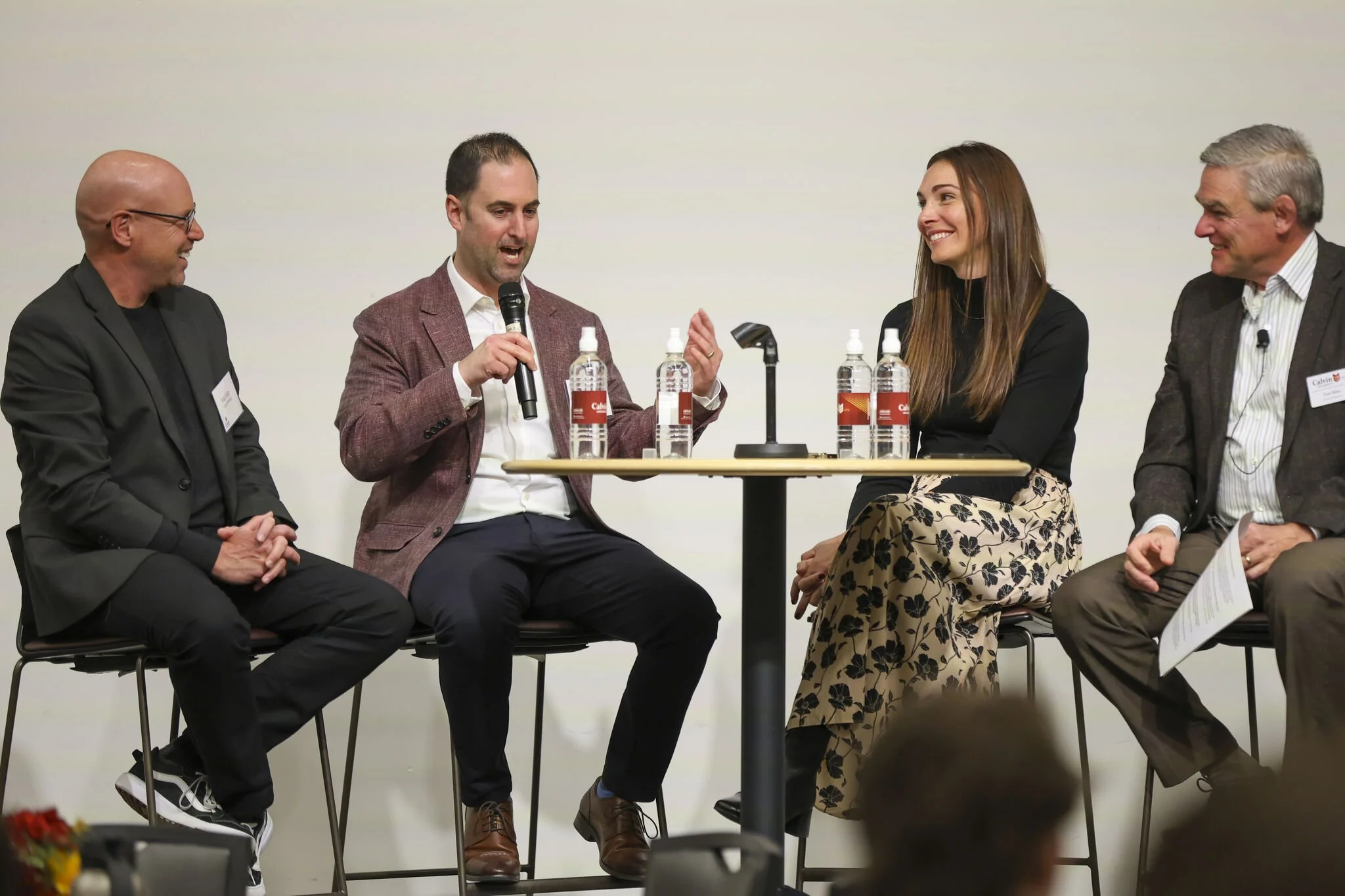
Calvin University's Executive Breakfast Series panel participants from left to right: Brian Scharp, Mike Wolf, and Stephanie Boer.
conclusion
How do you know if your agency is using AI responsibly?
Ask them. It's a fair question, and any good agency should be able to answer with transparency. What you should be looking for is an agency that can tell you specifically how AI fits into their process, where human creation and review happen, and how they make sure the final work reflects your brand, not just a plausible-sounding version of it. Red flags: vague answers, defensive responses, or an agency that leans on AI as a selling point without explaining what human oversight looks like. The tool is not the strategy. At Mix, we're transparent about our process. Every project starts and ends with people; AI just helps us make the most of the time in between.

Ready to work with a team that knows how to use every tool in the box?
Let's talk.
Frequently Asked Questions
Can't I just use AI tools directly and skip the marketing agency?
For some tasks (like quick research, summarizing a document, or providing high-level data analysis) AI works just fine. But high-quality strategy, original brand development, and true audience connection require more than AI can provide. This kind of work requires someone with years of strategic experience who knows your business, understands your market, and can make judgment calls that move you forward. That's what an agency is for.
Does Mix use AI in client work?
Yes, selectively and transparently. We use AI to work more efficiently on the parts of the process where speed and volume matter. Our strategists and creatives still lead every project, and every deliverable goes through human review and rounds of revision before it goes anywhere near a client. The thinking and creativity are ours. The execution is a collaboration.
Is AI-generated content bad for SEO?
Not inherently…but thin, generic, or obviously templated content is. Search engines care about helpfulness and relevance, and those qualities come from content that actually has something specific to say. AI can help produce more content, faster. It can not make that content meaningfully better without human input. Quality still wins the visibility race.
Will AI replace creative agencies?
No, but it will continue to change what agencies do and how they do it. Agencies that use AI to empower their teams to do more of what only humans can do well will be stronger for it. And agencies that use AI as a shortcut to do less thinking—frankly, it will show. At Mix, we’ll always choose to let human-led creativity take the lead.
How do I evaluate whether my marketing partner using AI responsibly?
Ask about their workflow. Are they using AI tools? How? What do they use AI for, and what does their team still handle themselves? A thoughtful, specific answer is a good sign. A pitch that leads with “'we use the latest AI,” without explaining how, is not.